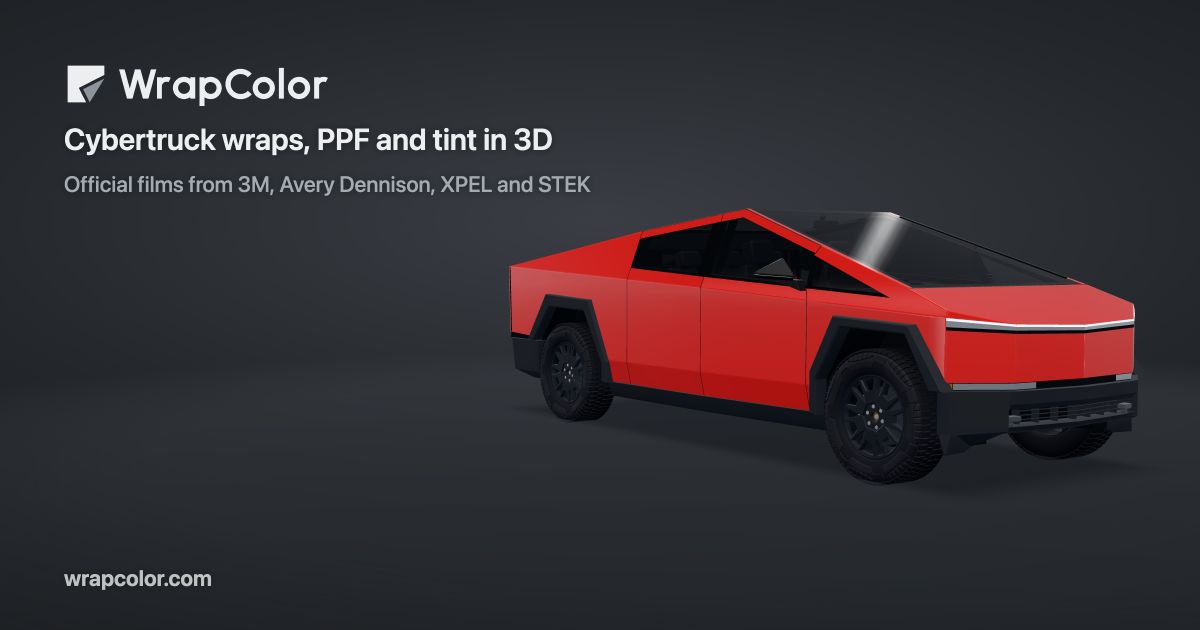
Not a Cybertruck? Try your own car
WrapColor is a free car wrap visualizer. Try 1,338 real wrap and colored PPF films from 11 makers on a photo of your own car, or on another 3D vehicle. You don’t need an account, and your photo is processed in your browser.
Or pick a 3D vehicle
Estimate your Cybertruck wrap cost
Typical US prices based on rates published by shops and Tesla in 2024–2026. Choose a film and how much of the truck to cover.
Estimated price
$3,200 to $6,000
About 2–4 days at the shop
- Satin vinyl, full wrap$3,200 – $6,000
- Total$3,200 – $6,000
Prices researched October 2026. How we estimate
Estimates only. Prices vary by shop, film and condition.
DIY kit instead
$1,300 – $1,700 film only
- Color vinyl kits from TWRAPS, DIY Wrap Club and VIP
Before you do it yourself
- Plan on a weekend: kit sellers and buyers report 8–16 hours for a full body, and edges take the most care.
- Kits include squeegees and an edge tool. You need a clean indoor space at about 65–75 °F, a heat gun for the edges and, for PPF, a slip solution.
- Film makers’ long warranties usually require a professional install (XPEL’s 10-year PPF warranty does). Kit warranties cover the film, not your workmanship, and a botched piece means buying a replacement.
- Prices are for the film only, and kits skip parts shops wrap, such as the vault cover.
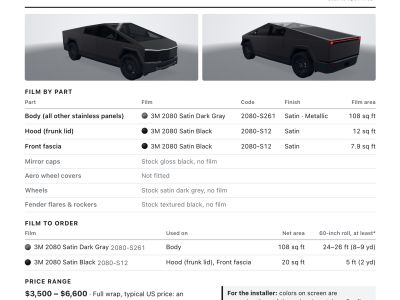
Bare stainless is selected in the viewer, so this starts with satin vinyl. Vinyl is thin (about 3–4 mil) color-change film with light protection.
Shops can put clear PPF over vinyl, for example on a wrapped hood, to take rock chips.
What you can try


More free tools
- Car wrap cost calculator: typical prices by vehicle and coverage, from shops’ price lists
- Window tint cost calculator: typical prices by vehicle type, windows and film, from shops’ price lists
- Window tint simulator: 5% to 70% on a 3D car
- Tint percentage chart: 5% to 70% from the driver’s seat
- Car wrap visualizer: real films on a 3D car or a photo of yours
- Vinyl wrap calculator: how much film to order
- Peel for shops: a free 3D visualizer for your shop’s website
Cybertruck wrap FAQ
How much does it cost to wrap a Cybertruck?
In an average-cost US area, a full color-change vinyl wrap typically runs about $3,200 to $6,200 in gloss, satin or matte, $3,500 to $6,600 in metallic, $3,800 to $8,000 in color-shift and $5,300 to $9,800 in chrome. Full-body clear paint protection film (PPF) runs about $4,000 to $7,500, and colored PPF about $4,400 to $8,300. Premium-brand film, big-city shop rates and extras such as door jambs or the vault cover add to that. These are estimates based on prices published in 2024–2026, and actual quotes vary by shop.
Does Tesla offer a Cybertruck wrap?
Tesla offered its own Cybertruck wraps at select service centers from late 2023: first in paint protection film ($6,000 to $6,500 for colors, $5,000 for clear satin), then in vinyl for $4,500 from December 2024. In August 2026, Not a Tesla App reported that Tesla had quietly ended the wrap service and that Tesla still sells XPEL paint protection film installed by certified third-party shops. Check the Tesla app or your service center for what is offered now.
How long does it take to wrap a Cybertruck?
Shops typically quote about 2 to 4 days for a full vinyl wrap and 2 to 5 days for full-body PPF, which covers washing, degreasing, installing and trimming along the truck’s sharp creases. Chrome and color-shift film, door jambs and the vault cover can add time, while partial wraps and accents usually take a day or two. At least one mobile installer using pre-cut kits advertises vinyl installs of about four hours.
Can you wrap a Cybertruck’s stainless steel body?
Yes, and Tesla itself offered PPF and vinyl wraps for it, but bare stainless takes more care than paint. 3M says its 2080 wrap film is “NOT intended for stainless steel,” and Avery Dennison lists stainless steel as an unsuitable surface for its SW900 film, so the film maker’s warranty may not apply. Experienced installers rely on thorough degreasing and careful edge work, so ask how a shop preps the panels and get its own workmanship warranty in writing.
Can a wrap damage the Cybertruck’s stainless steel?
A wrap can’t peel paint off a Cybertruck because there is none, but there is no clear coat either: Tesla notes that scratches are in the stainless panels themselves, so a blade slip while trimming film marks the steel. Ask whether the shop uses knifeless tape or pre-cut patterns rather than cutting on the truck. Some owners have also reported faint outlines or discoloration after removing vinyl that had been on for months, and Avery Dennison does not warrant clean removal from stainless steel.
Should I get a vinyl wrap or PPF on my Cybertruck?
Vinyl is a thin film (about 3 to 4 mil) made to change the color, while paint protection film is a thicker (about 8 to 10 mil), usually self-healing urethane made to absorb rock chips and light scratches; it comes clear in gloss or satin, or in colors. Choose PPF if protecting the stainless matters most and vinyl if you mainly want a new look for less. In an average-cost area, our estimate puts a full gloss vinyl wrap at about $3,200 to $5,800 and full-body clear PPF at about $4,000 to $7,500.
How long does a Cybertruck wrap last?
Film makers rate quality cast vinyl for years on vertical panels: Avery Dennison SW900 up to 10 years for standard colors (5 for metallics, 4 for color-flow film) in its mildest climate zone, and 3M 2080 up to 8 years. Ratings are much shorter for panels that aren’t close to vertical. Avery Dennison applies its horizontal rating to anything tilted more than 10° from vertical, which on a Cybertruck includes the frunk lid, the vault cover and the inward-sloping sail panels along the bed: 1 to 3 years for SW900 in the mildest zone and as little as a few months in hotter ones. 3M rates its gloss silver chrome at one year. XPEL backs its clear and colored PPF with a 10-year warranty when professionally installed.
How do I wash a wrapped Cybertruck?
Wait two to three days before the first wash: Avery Dennison says 48 hours, while 3M (for 2080 vinyl) and XPEL (for its colored PPF) say 72. Then hand wash with a pH-neutral car soap. Skip automatic brush and tunnel washes, and keep a pressure washer well back from film edges; XPEL advises about 3 feet for its colored PPF. Use only waxes, sealants or polishes the film maker approves: 3M lists approved waxes and polishes for gloss 2080 vinyl, and XPEL recommends its own Ceramic Boost sealant for its PPF. Avoid solvent-based cleaners, since Avery Dennison says products containing solvents or petroleum distillates void its film warranty, and keep wax and polish off matte film, which Avery warns can shift its color and sheen.
Can a Cybertruck wrap be removed?
Yes. Installers take vinyl and PPF off with heat and slow peeling, then clean off any adhesive left in the brushed grain of the steel; 3M warns that its chrome film may not remove the same way its standard films do. Our estimate allows $400 to $1,500 to remove a full existing wrap, in line with general shop guides. Because bare stainless has no clear coat, ask how the shop handles leftover adhesive and whether its warranty covers removal.
Will a wrap or PPF void my Cybertruck warranty?
In the US, federal rules (16 CFR 700.10, under the Magnuson-Moss Warranty Act) generally stop a manufacturer from making your warranty depend on using only its own parts or service, but it can still deny coverage for damage that the wrap or its installation caused. Film makers add their own conditions: XPEL’s PPF warranty requires professional installation, and 3M does not warrant 2080 vinyl with a coating such as ceramic over it. Keep film off sensors, radar and driver-assist cameras, as 3M advises, and get the installer’s workmanship warranty in writing.
Satin, gloss or matte: which finish is best for a Cybertruck?
It’s mostly taste. Tesla charged the same for gloss, satin and matte vinyl, as do several shops, though some charge more for satin or matte. Matte film needs gentler care, because Avery Dennison warns that cleaners, wax and polish can shift its color and sheen. If you like the stainless look, satin clear PPF keeps the brushed finish visible; at least one installer notes that gloss clear film darkens it.
Can you wrap the vault cover, frunk and door jambs?
Yes. The frunk lid is normally part of a full wrap, but the vault (tonneau) cover’s slats are wrapped one by one and are often quoted separately; we estimate about $400 to $1,000, though few shops publish a price. Door jambs are usually extra too, about $500 to $1,500 in our estimate, and keep bare steel from showing when the doors are open. Ask how the shop makes sure the vault cover still opens and closes smoothly afterward.
Is a chrome wrap legal on a Cybertruck?
We found no US law that bans chrome vehicle wraps by name, but general rules on glare and driver visibility can still apply to very reflective finishes, and many states set separate tint and reflectivity limits for windows. Rules vary by state and city, so check your state’s vehicle code or DMV before choosing chrome, and ask whether a color change needs to be reported on your registration.
Can I wrap a Cybertruck myself, and how much film does it take?
You can: pre-cut DIY kits sell for roughly $1,200 to $2,100 for vinyl or PPF, versus about $3,200 to $5,800 for a professional gloss vinyl wrap. If you buy bulk film, owners and wrap sellers suggest anywhere from about 55 to 100 feet of 60-inch-wide vinyl (a standard roll is 75 feet), and one owner who measured every panel fit them into 45 feet with almost no margin for error. Kit sellers estimate about 8 to 16 hours for a first-timer, a slipped blade scratches bare stainless that can’t be touched up with paint, and some film warranties, including XPEL’s, only apply to professional installs.
Prices are estimates and vary by shop. Check film makers’ current documents and your local rules before you buy.